In 2026, authenticity, tech adoption, and evolving search behaviors will shape how you and your brand connect with an audience of educators, admins, and their networks. Here’s how to market to teachers in the upcoming year:
Trend 1: Micro-influencers Are Driving Decision Making and Spending
For years, education brands relied on mega-influencers for reach… but 2026 is all about trust and relatability. Micro- and nano-influencers, or those with smaller, highly engaged audiences, are proving far more effective at driving authentic connections. Why? Because their followers see them as peers, not internet celebrities. This matters in education, where teachers and administrators value practical advice from people who understand their day-to-day challenges and realities.
Alongside influencer partnerships, user-generated content (UGC) has been a cornerstone of marketing strategies. This approach is especially important when considering how to market to teachers, as micro-influencers in education create relevant and relatable content—classroom photos, lesson ideas, and real-life tips that resonate authentically with their peers. Therefore, brands that remember to amplify this content (rather than pushing polished, corporate messaging) build both credibility and community.
Educators are savvy.
They can spot overly promotional content a mile away. But by leaning into authentic voices, you can position your brand as a partner in education rather than just another name in a sea of advertisers. This approach not only boosts engagement, but should serve to strengthen long-term trust with your audience.
Trend 2: Gen Alpha is Now Gen AI
Between the White House’s push to integrate AI into schools and educators’ concerns about misuse, artificial intelligence is quickly becoming one of the most polarizing topics in education. Teachers are caught in the middle—trying to harness AI’s potential to save time, personalize learning, and improve outcomes while managing ethical concerns, student misuse, and fears of being replaced by tools they’re still learning to navigate.
For educators, the key is balance: How can schools embrace AI’s power without losing sight of human judgment, creativity, and relationships in the classroom? For education-focused brands, this tension represents both a challenge and an opportunity—especially for those exploring how to market to teachers in a rapidly evolving AI landscape. Teachers are eager for trustworthy guidance; think tools, lessons, and professional development that make AI approachable, transparent, and classroom safe. Strong marketing and content strategies that take that into account are critical.
Products and messaging that emphasize AI awareness and responsible use will build credibility and trust at a time when educators crave clarity. Whether through free lesson plans, educator-facing webinars, or campaigns highlighting ethical AI use, helping teachers feel empowered—not anxious—about AI is the smartest move your brand can make right now.
Trend 3: You Can’t Leave GEO Behind
Educators aren’t just Googling anymore. They’re asking questions in ChatGPT, Perplexity, Google AI Overviews, and other generative tools. Instead of a list of links, these platforms deliver synthesized, conversational answers. To stand out to educators, brands need to prioritize both answer engine optimization (AEO) and generative engine optimization (GEO).
This means content needs clear structured schema, FAQs (when appropriate) and original, authentic educator-facing resources that are easily referenced and summarized by AI. GEO also emphasizes context-rich, semantically strong content that can be cited or paraphrased by generative models in response to educator queries.
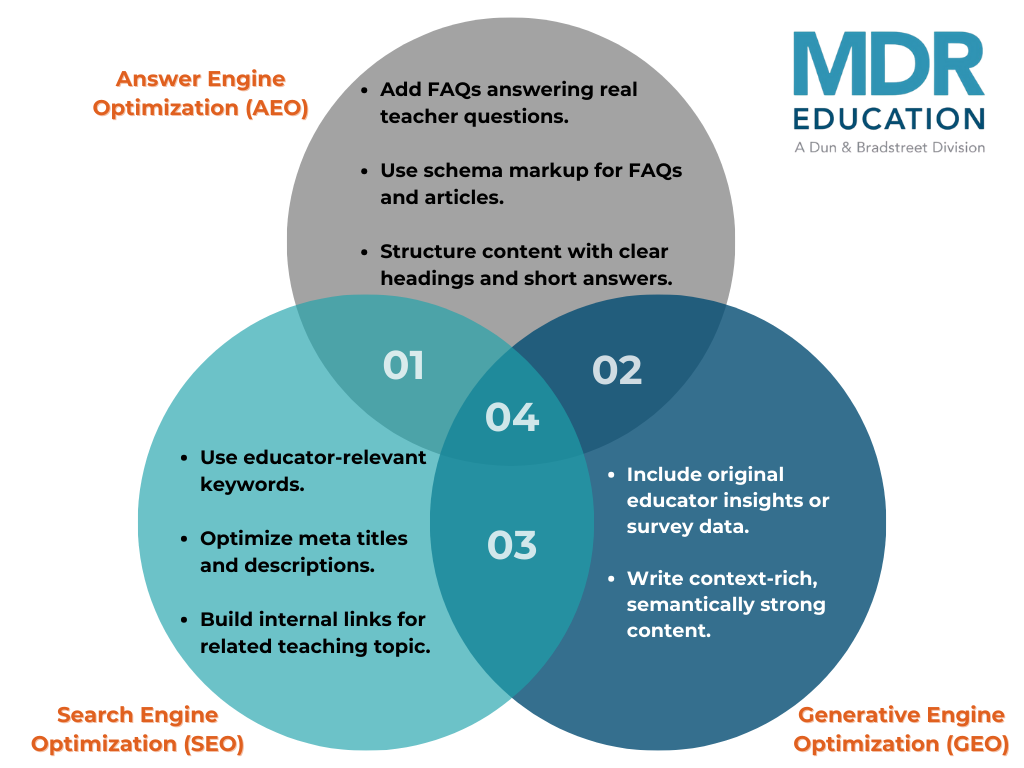
Even within Google, search results often return AI Overviews above traditional search results to give educators direct, conversational answers without requiring them to click any links. In other words, if your brand’s content isn’t optimized for generative AI, it might be skipped over—no matter how good it is.
Trend 4: We’re All Using Social as Search
Chances are, you’ve used the search bar in a social media app once or twice looking for everyday inspiration. Think DIY gifts or trendy living room wall colors. Teachers are doing the same thing. They’re using social media platforms—like TikTok, Instagram, and YouTube—as search engines. If an educator is planning to teach multiplication and still needs a review activity, for example, they’re likely heading to Instagram and typing in “fourth grade multiplication activities.”
To set your brand up for success, think like a teacher when writing your social media copy. Understanding how to market to teachers on platforms like TikTok and Instagram means optimizing captions, hashtags, and video titles for educator-driven searches. If your content can show up in those search results, you’re already ahead. The more relevant keywords you can naturally weave into your captions, the more likely you are to capture that kind of search-driven reach across social platforms.
To get started, brands will want to optimize content for queries like “best classroom management tools” or “free STEM lesson plans.” To keep it simple, use SEO-style captions, hashtags, and video titles.
Trend 5: Online Games Are Driving Big Numbers
Remember, gamification isn’t just a buzzword—it’s a proven way to boost engagement and learning outcomes in just about any classroom. As such, teachers are constantly looking for interactive tools that make lessons fun and memorable. And when brands provide templates, tools, or inspiration for these classroom-ready games, they position themselves as partners in both innovation and problem-solving.
Five years ago, building a custom game meant big budgets and long timelines. Today? You can prototype a word game using ChatGPT in one afternoon. Last year, we explored creating games for our media brand, We Are Teachers. We asked AI to code a simple word puzzle. Within hours, we had a functioning game embedded on our site. It wasn’t perfect, but it gave us something to test right away. After refining with a professional team, we cut costs by 50% and sped up development significantly.
- Dive in—experiment, test, and ask AI to generate code.
- Do a competitive analysis to understand the landscape.
- Apply your branding and company values throughout.
- Hire professionals for polish and final touches.
- Don’t skip on graphics or art—good visuals make a big difference.
- Don’t copy someone else’s idea. Make it your own.
- Don’t assume people will find it just because it exists. Promotion is key.
- Don’t launch without thorough testing and user feedback.
If you want to try this for yourself, you can ask AI to write code for a specific game, then iterate, test, and make it your own. Or reach out to us—we can help bring your game idea to life and handle promotion.
Helping you integrate trends strategically
As you plan your strategy and explore how to market to teachers in 2026, keep these digital marketing trends 2026 in mind. The brands that succeed will be those who prioritize authenticity, embrace new technologies, and meet educators where they are—whether that’s on social platforms, in the classroom, or through innovative resources. Ready to take your education marketing to the next level?
Contact us today to learn how we can help you connect with teachers, schools, and administrators in 2026 and beyond.